
“There was always a strong connection”
GAHF intern Nike Heinen interviewed Robert Kleih from the Ferring Foundation on Dec. 11, 2025, and questioned him about how Föhr Frisian immigrants maintained close ties to their island while living in two different national and cultural spaces.
 The foundation, which is located on the island of Föhr in the North Sea, is dedicated to preserving the language and culture of North Frisia, and was founded in the late 1980s by Frederick Paulsen. In addition, the foundation has a large archive with material covering over 400 years of the island’s history. Robert Kleih researches linguistics on Föhr and supports the preservation of local traditions.
The island differs from the mainland, and one custom that still shapes everyday life on the island is the informal way people address one another. Unlike in many parts of Germany, where formal forms of address signal hierarchy, Föhr’s informal language creates a more egalitarian atmosphere. I was able to visit the Island as a seasonal worker and learned about the history. Föhr Frisians are located in the very north of Germany, in the state of Schleswig-Holstein. My stay inspired me to learn more about Föhr, conversation focused on the Island of Föhr, the second largest of the North Frisian Islands. Despite its size, Föhr has a small population of around 8,000 people who live on the island year-round. Linguistically, the island is diverse: alongside standard German, Low German and Frisian are still spoken.
Beginning in the 19th century, many Frisians left Föhr due to declining opportunities in whaling, growing families as health conditions improved, and broader economic and political challenges. The United States became a key destination, with many migrants settling in New York. Others formed communities around Chicago, Ill., and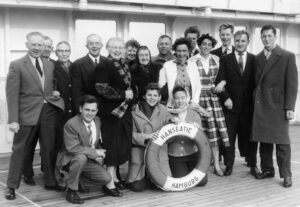 Petaluma, Calif. In New York, Frisian migrants initially found work in delis. Many opened small, family-run businesses selling sandwiches, salads, and basic groceries. Over time, they expanded into a wide range of professions.
Despite the distance, strong ties to Föhr remained. Families stayed in contact through letters, and visits back to the island often lasted several months, but were not possible every year. Migration did not always mean permanent separation: through different waves of movement, some family members returned to Föhr while others stayed in the United States.
This sense of solidarity was mirrored in New York. Frisians established a mutual aid organization called the Föhrer und Amrumer Krankenunterstützungsverein (Föhr and Amrum Sickness Benefits Association) and still exists today. The association supported members in times of illness but also functioned as a kind of internal marketplace. It helped facilitate the transfer or sale of businesses, like the delis, when someone returned to Germany, planned a marriage, or faced financial crises such as the stock market crash of the 1920s.
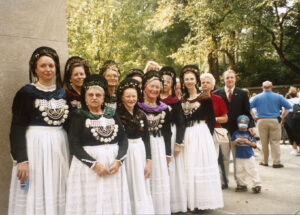 Frisians in the United States also preserved their traditional costume, or Tracht. The costume consists of a fine black dress paired with delicate silver jewelry and is worn on special occasions such as confirmations. In New York, it is still worn annually at the Steuben Parade by members of the Föhrer and Amrumer Krankenunterstützungsverein. The Steuben Parade is a Parade in New York City to showcase German traditions and culture. In areas such as food culture, German and Frisian traditions often overlap, with dishes being claimed as distinct by both Frisians and mainland Germans. Migration also brought new influences back to Föhr. One example is the “Föhrer Manhattan,” a drink made with white and red vermouth, American whiskey, and a maraschino cherry, which has become very popular on the island.
During the World Wars, family members in the United States sent care packages to Föhr. In return, and particularly during Prohibition, Föhr residents sent alcohol hidden in cans labeled as traditional duck meat from the island. From the 1960s onward, increased tourism on Föhr changed migration patterns as fewer residents needed to leave the island to find work. While young people still move away today, they tend to stay closer, often relocating within Germany rather than overseas.
Those interested in learning more about Frisian history can visit the Dr.-Carl-Haeberlin-Friesenmuseum on Föhr, which presents the general history of the island’s people. Migration is explored in greater depth in larger port cities such as Hamburg and Bremerhaven, home to the German Migration Museum. The Ferring Foundation has also released a podcast, produced in collaboration with a studio in Hamburg, that follows the story of one family migrating to New York and back. The podcast is available in English. Anyone with Frisian heritage who still has letters or other records from this period is encouraged to contact ([email protected]) the Ferring Foundation for support in preserving this part of history.
This article is based on an interview with Robert Kleih. Listen to the full interview here.
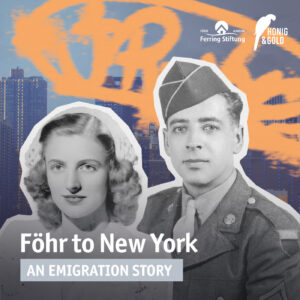 The link to the podcast “Föhr to New York – an Emigration Story” is at https://dev.ferring-stiftung.de/en/show/fohr-new-york-eng/