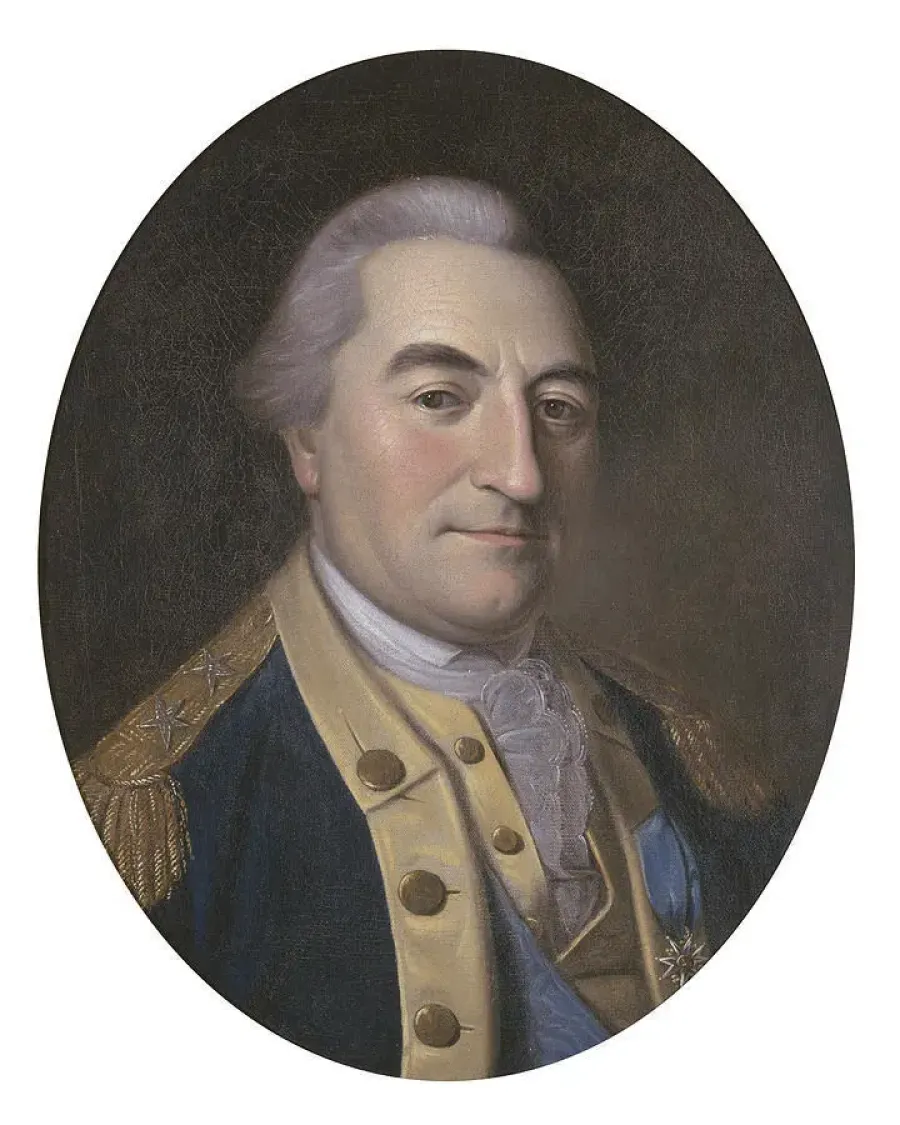
As we continue our introduction of German-speaking immigrants who helped shaped the United States, we shine today’s spotlight on General Johann de Kalb, a hero of the American Revolution.
Born in 1721 in the village of Hüttendorf near Erlangen, which then belonged to the Principality of Bayreuth, as the son of a humble farmer named Johann Kalb, he left home and used his experience as a waiter to find positions elsewhere. He studied French and acquired the social skills and connections to obtain a commission in 1743 as a lieutenant in the Régiment de Lowendahl, which primarily consisted of German and Swiss recruits.
He served with distinction in the Austrian Succession War in Flanders, and continued to climb the social & military ladder. During the Seven Years’ War, he was promoted to lieutenant colonel and became assistant quartermaster general in the Army of the Upper Rhine. He was awarded the Order of Military Merit in 1763 and ennobled with the right to carry the title of baron.
In 1764, he married a French cloth manufacturing heiress, left the army, bought a chateau, and led a quiet farming life. In 1768, he journeyed to North America on a covert French mission to gauge discontent among colonists towards France’s adversary Great Britain.
De Kalb’s four-month trip not only provided great insight for the French government, but de Kalb also admired the colonists’ spirit of independence. Back in France, he stated his wish to return to the colonies to join their impending uprising against the British. It took almost a decade before de Kalb returned to North America in July of 1777 with his protégé, the Marquis de Lafayette, to join the Continental Army. He had been promised commission as a major general, and was disappointed and upset to learn that the Continental Congress was not planning on honoring its promise. Lafayette convinced the Americans, and de Kalb was appointed to the rank on Sept. 5, 1777.
He spent the winter of 1777/78 at Valley Forge, and wrote letters of introduction to the French Royal Court for John Adams. In August of 1780, he joined the Battle of Camden where he was grievously wounded. His aide de camp identified him to the British General Charles Cornwallis who ordered his own surgeon to dress de Kalb’s wounds and expressed his sorrow at seeing him injured. De Kalb died on Aug. 19, 1780. George Washington visited his grave a few days after his death, and reportedly said: “So; there lies the brave de Kalb; the generous stranger; who came from a distant land to fight our battles; and to water with his blood the tree of liberty. Would to God he had lived to share its fruits!”
Our board members Klaus Becker who runs the Zeitgeist Foundation in Charlotte, NC and Matthias Weimer from Charleston, SC organized a lecture with author John Beakes.